SMT vs Through-Hole: Cost and Yield Tradeoffs

SMT assembly offers lower labor cost and higher component density but demands stricter process control. Through-hole assembly provides mechanical strength and easier repair at higher labor cost. The right choice depends on mechanical stress, component mix, and production volume.
- SMT assembly reduces labor costs but increases sensitivity to process defects.
- Through-hole assembly offers mechanical robustness and easier field repair.
- Mixed assemblies often provide the best balance for mechanically stressed boards.
- Yield rate depends on process control and inspection levels more than the assembly method alone.
- Choose based on component mix, mechanical requirements, and repairability needs.
How SMT and Through-Hole Assembly Differ in Cost Structure
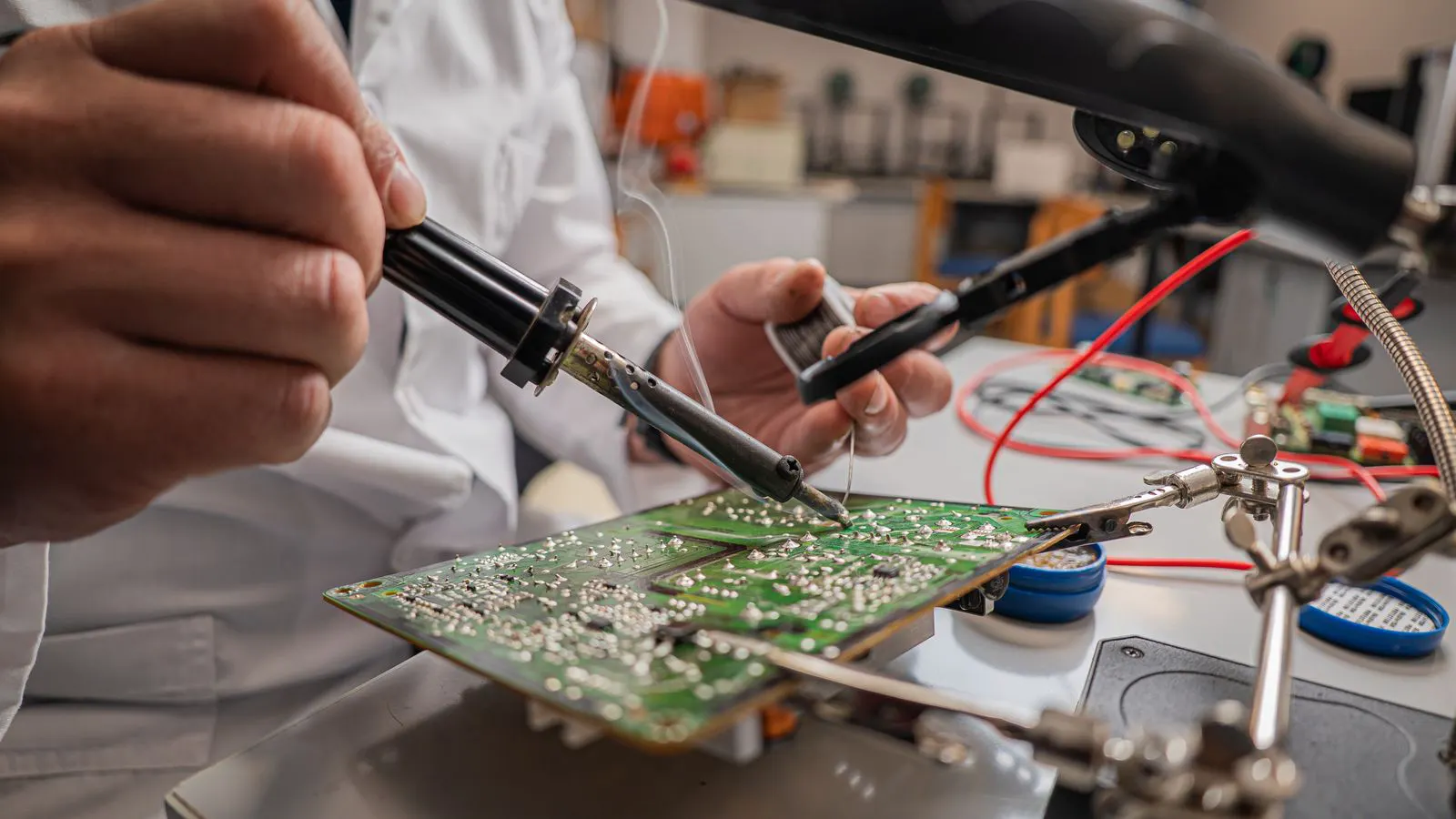
SMT assembly and through-hole assembly use different material and labor models. SMT assembly places surface mount components directly onto the copper pads using solder paste, an automatic placement machine, and a reflow oven. Through-hole assembly inserts component leads through plated holes in the board and forms solder joints by hand or with wave soldering.
The cost structure differs in predictable ways. SMT assembly has a higher upfront tooling cost because it requires stencil printing, pick-and-place equipment, and precise solder paste inspection. Through-hole assembly uses less specialized equipment but consumes more labor hours per board.
In high-volume production, SMT assembly usually wins on unit cost. The placement speed of automated machines and the ability to place dense component arrays keeps labor cost per component low. Through-hole assembly remains competitive in low-volume or custom boards where setup costs dominate the total.
The solder paste and component cost for SMT assembly is often higher than through-hole equivalents. Surface mount components are smaller and more expensive to manufacture. Through-hole resistors, capacitors, and transistors are typically cheaper per unit but require more board area and thicker copper traces.
How Yield Rate Changes with Assembly Method
Yield rate is the percentage of boards that pass all inspection and functional tests. The method used affects yield in different ways.
SMT assembly has higher sensitivity to process defects. A small amount of solder paste can cause bridging between adjacent pads. A misaligned component can create a cold joint or open circuit. A component can lift during reflow and land on the wrong pad.
Through-hole assembly has different failure modes. Component leads can bend during insertion. Solder can bridge between adjacent holes. Components can be inserted in the wrong orientation. Wave soldering can remove too much solder from through-hole joints.
The key difference is inspection difficulty. SMT defects are microscopic and require automated optical inspection or X-ray inspection. Through-hole defects are visible to the naked eye and easier to catch with manual inspection.
SMT assembly yield improves when the design team controls the component footprint, minimum pad spacing, and solder paste stencil aperture. Through-hole assembly yield improves when the design team controls hole size, lead spacing, and component tolerance.
When to Pick SMT Assembly
SMT assembly fits projects that prioritize component density and automated production. It is the standard choice for consumer electronics, automotive control units, and communication equipment.
Choose SMT assembly when the board has more than a few surface mount components. The labor savings compound quickly as component count increases. A board with 100 surface mount components is significantly cheaper to assemble than one with 100 through-hole components.
SMT assembly also fits projects that require high reliability in small form factors. Surface mount components have smaller footprints and lower inductance. This allows tighter routing and better signal integrity in high-speed designs.
The tradeoff is repairability. SMT components are difficult to remove and replace. A failed surface mount component usually means replacing the entire board. This is acceptable for consumer products and vehicle electronics where replacement is cheap and fast.
When to Pick Through-Hole Assembly
Through-hole assembly fits projects that require mechanical strength and easy field repair. It is common in industrial equipment, power supplies, test gear, and military hardware.
Choose through-hole assembly when the board experiences vibration, shock, or thermal cycling. Through-hole joints mechanically anchor the component to the board. Surface mount joints rely on solder fillets and are more susceptible to cracking under stress.
Through-hole assembly also fits projects that need field service. A technician can remove a failed component with solder wick and a desoldering pump. The part can be replaced without reflowing the entire board. This saves time in the field.
The tradeoff is board area. Through-hole components take up more space. The board must have thicker copper traces to carry the same current. This limits component density and increases board size.
Mixed Assembly: The Practical Middle Ground
Many production boards use a mixed assembly. The board contains both surface mount and through-hole components. The assembly process runs both methods in sequence.
Mixed assembly is common when a design has a mix of high-speed digital components and high-power analog components. Surface mount components handle the high-speed signal paths. Through-hole components handle the power connections, connectors, and large capacitors.
The cost advantage of SMT assembly still applies. The labor savings on the surface mount portion offset the higher cost of the through-hole portion. The yield advantage of through-hole assembly applies to the mechanical and power sections.
The main challenge is process control. The board must go through reflow soldering first to place the surface mount components. Then it goes through wave soldering or manual soldering to place the through-hole components. Each step adds a chance for defects.
The design team must control the component footprint and pad layout. Surface mount pads must be spaced far enough apart to prevent solder bridging. Through-hole pads must be sized correctly for the lead diameter. The board must have adequate copper area to carry the combined current.
How to Evaluate the Best Balance for Your Project
The choice between SMT and through-hole assembly depends on three factors: component mix, mechanical requirements, and repairability.
For the component mix, count the surface mount and through-hole components. If the majority are surface mount, SMT assembly is the logical choice. If the majority are through-hole, through-hole assembly or mixed assembly is better.
For mechanical requirements, look at the operating environment. If the board sees vibration, shock, or thermal cycling, through-hole assembly is safer. If the board is in a controlled environment, SMT assembly is acceptable.
For repairability, ask who will service the board. If a field technician will repair it, through-hole assembly is easier. If the board is replaced as a unit, SMT assembly is fine.
The table below summarizes the main tradeoffs.
| Option | Best for | Limitations |
| SMT assembly | High component density, low labor cost, automated production | Higher sensitivity to process defects, harder field repair, higher component cost |
| Through-hole assembly | Mechanical strength, field service, low-volume production | Higher labor cost, larger board area, slower assembly |
| Mixed assembly | High-speed digital with high-power analog, mechanical stress and repairability | Complex process control, multiple inspection steps, higher setup cost |
How to Improve Yield in Either Method
Yield rate depends on process control more than the assembly method. The design team and the assembly house must align on the same goals.
For SMT assembly, the design team must provide accurate component footprints and pad layouts. The assembly house must use proper solder paste stencil and aperture. The reflow profile must be tuned for each board material. Automated optical inspection must be used to catch defects.
For through-hole assembly, the design team must provide correct hole size and lead spacing. The assembly house must use proper solder paste and wave soldering profile. Manual inspection must be used to catch defects.
The inspection level matters. A board with 100 surface mount components that passes 100 percent automated optical inspection will have a different yield than a board with 100 surface mount components that passes only sample inspection. The cost of inspection is part of the total assembly cost.
The number of inspection steps also matters. A board that goes through reflow, optical inspection, X-ray inspection, and functional testing will have a different yield than a board that goes through reflow and functional testing only. Each inspection step adds cost but also improves quality.
The final choice should come from the design review. The engineer who designed the board must state the mechanical requirements, the expected operating life, and the field service plan. The assembly house must quote the cost for each method. The buyer should compare the total cost of ownership, not just the assembly price.
The best balance is rarely the cheapest option. It is the option that delivers the required reliability at the required cost. SMT assembly and through-hole assembly both have their place. The project requirements decide which one wins.
Frequently asked questions
Which assembly method has a lower cost per board?
SMT assembly usually has a lower cost per board in high-volume production. Through-hole assembly has a lower cost per board in low-volume production where setup costs dominate.
Which assembly method has a higher yield rate?
The yield rate depends on process control and inspection level. Through-hole assembly is easier to inspect manually. SMT assembly requires automated optical inspection or X-ray inspection to reach comparable yield.
Can I use both methods on the same board?
Yes. Mixed assembly is common. The board goes through SMT assembly first, then through-hole assembly. The process control must be managed carefully to avoid defects.
Which method is better for field repair?
Through-hole assembly is better for field repair. Components can be removed and replaced without reflowing the entire board. SMT assembly usually requires replacing the whole board.
How do I decide which method to use?
Look at the component mix, mechanical requirements, and repairability. If the board has many surface mount components and needs to be repaired in the field, use through-hole assembly or mixed assembly. If the board has many surface mount components and will be replaced as a unit, use SMT assembly.